
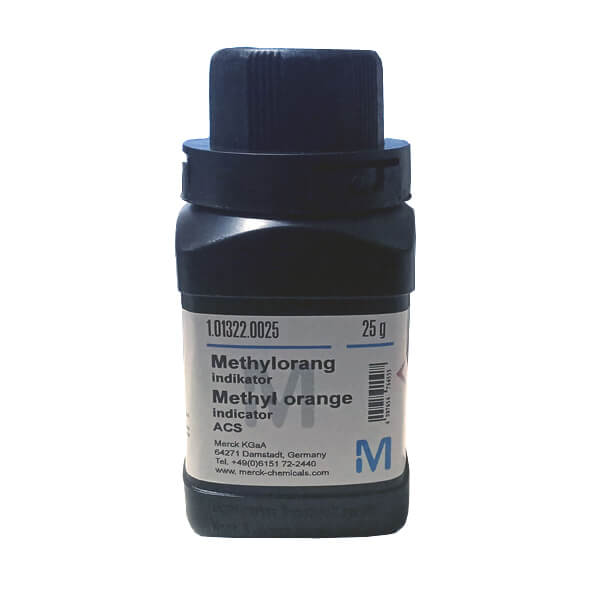
Methyl Orange Indicator 25g Merck Germany
৳ 750.00
Methyl Orange Indicator
- Methyl Orange Indicator
- Pack Size: 25g
- Brand: Merck
- Origin: Germany
Description
Methyl Orange Indicator (C.I. 13025) by Merck Germany is a highly effective pH indicator widely used in analytical laboratories for acid-base titrations. With the chemical formula C₁₄H₁₄N₃NaO₃S and a molecular weight of 327.34 g/mol, it is commonly known by several synonyms such as 4-Dimethylaminoazobenzene-4′-sulfonic acid sodium salt, Gold Orange, Helianthine, and Orange II.
Features of Methyl Orange Indicator (25g, Merck):
-
Sharp Color Change Range:
-
Red at pH < 3.4 (acidic conditions)
-
Orange at pH 3.4–4.4 (transition)
-
Yellow at pH > 4.4 (alkaline conditions)
-
-
Typically used in titrations involving strong acids and weak bases
-
Supplied as a powder, soluble in water or alcohol to create an indicator solution
Common Applications of Methyl Orange Indicator:
1. Acid-Base Titrations
Ideal for titrating strong acids (e.g., HCl) with weak bases (e.g., sodium carbonate). Its distinct color transition makes it perfect for identifying the equivalence point accurately.
2. Water Quality Testing
Used for testing pH levels in industrial wastewater and effluents, especially in acidic ranges.
3. Soil Analysis
Helps determine soil acidity, useful in agricultural and environmental studies.
4. Food and Beverage Industry
Utilized in pH testing of canned foods, beverages, and dairy products to monitor acidity levels.
5. Chemical Quality Control
Used in quality checks of chemicals to ensure proper acidity before use in formulations or synthesis.
6. Qualitative Analysis
Supports the detection of acidic components in inorganic qualitative analysis.
7. Educational & Acid-Base Equilibrium Studies
Favored in academic labs for its clear and sharp transition in color, enhancing student understanding of acid-base concepts.
Related Items

৳ 3,190.00 Original price was: ৳ 3,190.00.৳ 2,990.00Current price is: ৳ 2,990.00.

৳ 850.00 Original price was: ৳ 850.00.৳ 800.00Current price is: ৳ 800.00.
Reviews
There are no reviews yet.